Day Without Art Raphael the Agony in the Garden
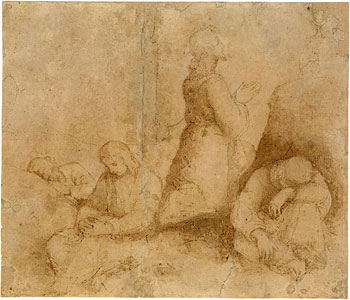 Raphael (1483–1520)
Agony in the Garden, 1503–5
Pen and brown ink, brown wash, traced with a stylus and pricked for transfer. Extensive repairs of breaks and losses.
226 x 165 mm
Watermark: None
Inscribed on verso, at lower center, in pen and brownish ink, Timoteo Viti.
Purchased by J. Pierpont Morgan: acc. no. I, xv
This drawing shows the kneeling figure of Christ in prayer on the Mountain of Olives just prior to his abort and ensuing Passion, accompanied by the apostles Peter, James, and John, all of whom—despite Christ's pleas—had fallen asleep. According to the Gospel of St. Luke, an affections appeared to Christ to give him strength.
The Morgan sail has long been connected with one of the three predella panels of Raphael's Pala Colonna, painted for Sant'Antonio di Padova in Perugia, the conventual church of cloistered Franciscan nuns.one The conservative composition of this early on altarpiece and the lyrical beauty of its figures reveal the strong influence of Pietro Perugino, with whom Raphael may accept worked after initial preparation with his father, Giovanni Santi.2 The Desperation in the Garden console faithfully reproduces the drawing's limerick, with one exception: in the preliminary study, the chalice stands on the cliffs equally upon an altar; in the panel, it is held aloft by a flying angel and presented to Christ. Presumably, this late adjustment, which aligned the piece of work with the prevailing Umbrian tradition, was occasioned by the conservative taste of the Franciscan nuns.
A typical method for transferring the design from a cartoon (a drawing done on the same scale as the finished painting) is to prick the outlines then apply a dark chalk pulverization (spolvero) to the surface in order to create a pattern of holes delineating the image on the gessoed console beneath. These marks are then used to guide the execution of the painting. The outlines of the Morgan cartoon are indeed pricked for transfer, and the canvass is on the same scale as the predella panel. Curiously, however, and in contrast to the other ii predella panels—the Pietà in the Isabella Stewart Gardner Museum, Boston, and the Procession to Calvary in the National Gallery, London—no trace of spolvero tin be found on the Metropolitan Museum'south panel. Possibly the paint layers are too dense for any underdrawing to appear in infrared reflectography. Interestingly, on the Morgan study there are several pricked lines that lack visible corresponding pen lines or washes beneath, probably because such indications in ink were lost over fourth dimension, and indeed the cartoon is in very poor condition.3
Precisely when the altarpiece and its predella were painted is a matter of some conjecture since the work is not inscribed with a appointment nor are there documents relating to the commission. It is more often than not agreed, based on way and coexisting evidence, that the work was created between 1503 and 1505. This would place it afterward Raphael had left Urbino to work in Perugia and perhaps make information technology contemporaneous with the completion of his designs for frescoes in the Piccolomini Library attached to Siena Cathedral (1502–3) and his first long sojourn in Florence, where he arrived in October 1504. Furthermore Chiliad. F. Waagen, a nineteenth-century fine art historian, claimed to take seen a date of 1505 on the altarpiece; still, no trace of such an inscription remains today. Interestingly, J. Pierpont Morgan—who had acquired the drawing in 1909 as part of the Fairfax Murray collection—also in one case owned the main panel of the altarpiece representing the Virgin and Child Enthroned with Saints, with God the Begetter, Angels and Cherubim.
Rhoda Eitel-Porter
1. Oil on wood, 24 ten 29 cm, Inv. 1932.130.ane Provenance: Select Bibliography: Paul Joannides, The Drawings of Raphael. With a Complete Catalogue, Oxford, 1983, p. 152, fig. 83. Eckhart Knab, Erwin Mitsch, and Konrad Oberhuber, Raphael: Die Zeichnungen, Stuttgart, 1983, p.59, no. 24. Linda Wolk-Simon, Raphael at the Metropolitan Museum. The Colonna Altarpiece, (reprint of The Metropolitan Museum of Art Message, bound, 2006), exhibition catalogue, Metropolitan Museum, New York, 2006, pp. 21, 69, fig. 33, no. 17; Rhoda Eitel-Porter, in 100 Chief Drawings from The Morgan Library & Museum, exhibition catalogue, Staatliche Graphische Sammlung in the Pinakothek der Moderne, Munich, 2008-2009, pp. 38-39, no. 10, repr.
2. Come across Hugo Chapman, Tom Henry, and Carol Plazzotta, with contributions from Arnold Nesselrath and Nicholas Penny, Raphael from Urbino to Rome, exhibition catalogue, National Gallery, London, 2004, pp. 16–xx, for a discussion of Raphael's early years and training.
3. Plazzotta suggested that the study may have been an auxiliary cartoon pricked through from some other sheet, with the pricking lying beneath the pen-and-ink drawing (Carol Plazzotta, Raphael exhibition review, Burlington Magazine, vol.148, no.1243, Oct 2006, p.709). Examination in 2008 with the director of the Thaw Conservation Center at the Morgan Library & Museum, Margaret Holben Ellis, however, revealed that this does not seem to exist the case; therefore the cartoon surely is Raphael'south original design, every bit has generally been thought.
Peradventure Viti-Antaldi (co-ordinate to Charles Fairfax Murray; drawing does non bear whatever of the Antaldi marks and cannot be identified in the Antaldi Inventory); Frederick, Lord Leighton (1830–1896), London; his sale, London, Christie's, 16 July 1896, lot 447, as Timoteo Viti "Christ in the Garden of Olives— pen and bistre" (to Murray for £xx.0.0); Charles Fairfax Murray (1849–1919), London and Florence; from whom purchased through Galerie Alexandre Imbert, Rome, in 1909 by J. Pierpont Morgan (1837–1913), New York (no mark; come across Lugt 1509); his son, J. P. Morgan, Jr. (1867–1943), New York.
Charles Fairfax Murray, Collection of Drawings by the Sometime Masters formed past C. Fairfax Murray (J. Pierpont Morgan Drove), four vols., London 1905–12, vol. I, no. 15, repr.
Source: https://www.themorgan.org/collection/rome-after-raphael/agony-garden
0 Response to "Day Without Art Raphael the Agony in the Garden"
Postar um comentário