Pop Song Fighting Agains Use of Torture

An Iraqi human being looks at posters in May 2005 showing Iraqi prisoners held in the notorious U.S.-run Abu Ghraib prison in Baghdad. A new U.S. war machine transmission bans the use of torture techniques such as hooding and forced nakedness. Karin Sahib/AFP/Getty Images hide caption
toggle explanation
Karin Sahib/AFP/Getty Images
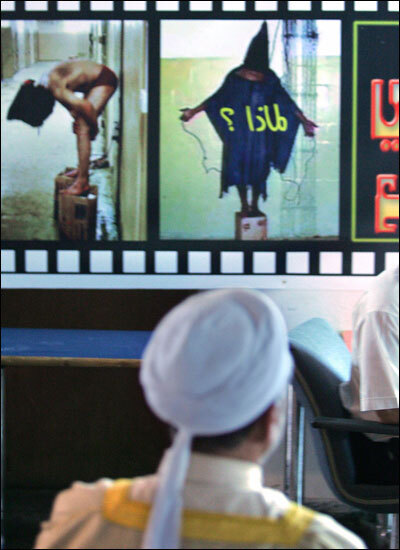
An Iraqi man looks at posters in May 2005 showing Iraqi prisoners held in the notorious U.S.-run Abu Ghraib prison in Baghdad. A new U.Southward. military transmission bans the use of torture techniques such equally hooding and forced nakedness.
Karin Sahib/AFP/Getty Images
WASHINGTON (AP) -- A new Army transmission bans torture and degrading treatment of prisoners, for the first time specifically mentioning forced nakedness, hooding and other procedures that have become infamous during the five-yr-old war on terrorism.
Delayed more than a year amid criticism of the Defense force Department's treatment of prisoners, the new Army Field Manual was beingness released Midweek, revising one from 1992.
It also explicitly bans beating prisoners, sexually humiliating them, threatening them with dogs, depriving them of food or water, performing mock executions, shocking them with electricity, burning them, causing other hurting and a technique chosen "water boarding" that simulates drowning, said Lt. Gen. John Kimmons, Army Deputy Chief of Staff for Intelligence.
Officials said the revisions are based on lessons learned since the Usa began taking prisoners in the state of war on terrorism subsequently the Sept. xi, 2001, attacks.
Release of the manual came amid a flurry of announcements about U.S. handling of prisoners, which has drawn criticism from Bush administration critics likewise every bit domestic and international allies.
The Pentagon likewise announced an overall policy statement on prisoner operations. And President Bush-league acknowledged the existence of previously hush-hush CIA prisons around the world where terrorism suspects accept been held and interrogated, maxim 14 such al-Qaida leaders had been transferred to the war machine prison house at Guantanamo Bay and will be brought to trial.
Human-rights groups and some nations take urged the Bush administration to shut the prison house at the U.S. naval base of operations in Guantanamo Bay, Cuba, since not long later on it opened in 2002 with prisoners from the campaign confronting al-Qaida in Afghanistan. Scrutiny of U.Due south. treatment of prisoners shot to a new level in 2004 with the release of photos showing U.S. troops beating, intimidating and sexually abusing prisoners at Abu Ghraib in Iraq -- and then once more with news of the hole-and-corner facilities.
Though defense officials before this year debated writing a classified section of the manual to keep some interrogation procedures a clandestine from potential enemies, Kimmons said Wed that there is no clandestine section.
Defense Secretary Donald H. Rumsfeld has said from the start of the counter-terror war that prisoners are treated humanely and in a manner "consequent with Geneva Conventions."
Just Bush decided shortly subsequently the Sept. 11 attacks that since it was not a conventional state of war, "unlawful enemy combatants" captured in the fight confronting al-Qaida would not be considered POWs and thus would not be afforded the protections of the convention.
The new manual, called "Human Intelligence Collector Operations," applies to all the armed services. It doesn't embrace the CIA, which too has come nether investigation for mistreatment of prisoners in Iraq and Afghanistan and for keeping suspects in secret prisons.
Sixteen of the transmission'due south nineteen interrogation techniques were covered in the old manual and iii new ones were added on the basis of lessons from the counter-terror war, Kimmons said.
The additions are that interrogators may employ the good-cop/bad-cop tact with prisoners, they may portray themselves equally someone other than an American interrogator, and they may utilize "separation," basically keeping prisoners apart from 1 another so enemy combatants can't coordinate their answers.
The last will be used merely on unlawful combatants, not POWS, merely as an exception and merely with permission of a high-level commander, Kimmons said.
Too Midweek, the Pentagon released a new policy directive on detention operations that says the handling of prisoners must -- at a minimum -- bide by the standards of the Geneva Conventions and lays out the responsibilities of senior noncombatant and military officials who oversee detention operations.
"The revisions ... took fourth dimension," Deputy Banana Secretary of Defense for Detainee Affairs Cully Stimson said at the briefing. "Information technology took time because it was of import to get it right, and nosotros did become it correct."
He said the directive pulls together policy changes recommended in a dozen investigations done after the Abu Ghraib scandal broke.
"By publishing this document and the Ground forces Field Manual, we will take addressed over 95 percent of the recommendations from those 12 major investigations since Abu Ghraib," Stimson said.
Amnesty International Us'south director, Larry Cox, said he was "pleased to see a direct repudiation of tactics previously approved for apply against detainees such as hooding, the use of dogs," as well every bit the acknowledgment that the Geneva Conventions apply.
Among members of Congress briefed on the manual Wednesday, Democrats praised information technology as a step in the right management and potentially helpful in preventing time to come prisoner abuse.
Republican Sen. John Cornyn of Texas said he was concerned that, considering the techniques are unclassified, information from the manuals could exist used past terrorists to resist interrogations.
Copyright 2006 by The Associated Printing. All Rights Reserved.
Source: https://www.npr.org/2006/09/06/5776259/new-army-manual-bans-torture-including-hooding
0 Response to "Pop Song Fighting Agains Use of Torture"
Postar um comentário