Draw This Again Meme 3 Blank

Kilroy was here is a meme[1] that became pop during World State of war II, typically seen in graffiti. Its origin is debated, but the phrase and the distinctive accompanying doodle became associated with GIs in the 1940s: a bald-headed human being (sometimes depicted equally having a few hairs) with a prominent nose peeking over a wall with his fingers clutching the wall.
"Mr Chad" or merely "Chad" was the version that became popular in the Britain. The character of Chad may take been derived from a British cartoonist in 1938, peradventure pre-dating "Kilroy was here". Co-ordinate to Dave Wilton, "Some time during the state of war, Chad and Kilroy met, and in the spirit of Allied unity merged, with the British drawing actualization over the American phrase."[2] Other names for the character include Smoe, Clem, Flywheel, Private Snoops, Overby, Eugene the Jeep, and Sapo.
According to Charles Panati, "The outrageousness of the graffiti was not so much what it said, but where it turned upwardly."[3] Information technology is not known if there was an actual person named Kilroy who inspired the graffiti, although at that place have been claims over the years.
Origin and use of the phrase [edit]

The phrase may have originated through U.s. servicemen who would draw the picture and the text "Kilroy was here" on the walls and other places where they were stationed, encamped, or visited. An ad in Life magazine noted that WWII-era servicemen were fond of claiming that "whatever beach-head they stormed, they always found notices chalked up ahead of them, that 'Kilroy was here'".[4] Brewer's Lexicon of Phrase and Fable notes that it was specially associated with the Air Ship Command, at least when observed in the United kingdom.[5] At some point, the graffiti (Republic of chad) and slogan (Kilroy was here) must have merged.[six]
Many sources claim origin as early as 1939.[iii] [seven] [eight] Earlier examples of the phrase dating from 1937 are unverified.
According to one story, High german intelligence constitute the phrase on captured American equipment. This led Adolf Hitler to believe that Kilroy could be the name or codename of a high-level Allied spy. At the time of the Potsdam Conference in 1945, it was rumored that Stalin found "Kilroy was here" written in the VIP bathroom, prompting him to ask his aides who Kilroy was.[ii] [9] War photographer Robert Capa noted a use of the phrase at Bastogne during the Battle of the Bulge in December 1944: "On the black, charred walls of an abandoned befouled, scrawled in white chalk, was the fable of Gen. Anthony McAuliffe's soldiers: KILROY WAS STUCK HERE."[10]
Foo was here [edit]
Digger History, the Unofficial history of the Australian & New Zealand Armed Services, says of Foo that "He was chalked on the side of railway carriages, appeared in probably every military camp that the 1st AIF World War I served in and more often than not fabricated his presence felt". If this is the case, then "Foo was here" predates the American version of World War Two, "Kilroy was here", past most 25 years.[ dubious ] "Foo" was thought of as a gremlin by the Purple Australian Air Force.[11] It has been claimed that Foo came from the acronym for Forwards Observation Officeholder.[ citation needed ]
Existent Kilroys [edit]
The Oxford English Dictionary says simply that Kilroy was "the name of a mythical person".[6]
One theory identifies James J. Kilroy (1902–1962), an American shipyard inspector, as the man behind the signature.[half-dozen] James Kilroy had served on the Boston City Council and represented the Roxbury commune in the Massachusetts Legislature during the 1930s. He worked at the Fore River Shipyard in Quincy during the war checking the work of riveters paid by how many rivets they installed.[12] Normally, inspectors made a pocket-sized chalk marking which riveters used to erase, so that they would be paid double for their piece of work. To prevent this, Kilroy marked work he had inspected and approved with the phrase "Kilroy was here" in more durable crayon.[13]
More than than forty candidates claimed to have originated the phrase and drawing in response to a 1946 contest conducted by the American Transit Association to plant the origin of the miracle.[14] [8] [15] James Kilroy was credited after his claim was verified by shipyard officials and the riveters whose work he inspected. While Kilroy's marks might usually take been painted over, interior painting was a low priority in the rush to launch ships, and then Kilroy'south marks were seen by thousands of servicemen who sailed aboard troopships built at Quincy.[12] A The New York Times article noted that Kilroy had marked the ships as they were beingness built equally a way to be sure that he had inspected a compartment, and the phrase would be found chalked in places that nobody could have reached for graffiti, such every bit within sealed hull spaces.[15] Brewer's Lexicon of Phrase and Fable notes this as a possible origin, but suggests that "the phrase grew by accident."[5]
The Lowell Sun reported in November 1945 that Sgt. Francis J. Kilroy Jr. from Everett, Massachusetts, wrote "Kilroy volition be hither next week" on a billet bulletin board at a Boca Raton, Florida, airbase while sick with flu, and the phrase was picked upwards past other airmen and quickly spread abroad.[16] The Associated Press similarly reported Sgt. Kilroy's account of beingness hospitalized early in World War Two, and his friend Sgt. James Maloney wrote the phrase on a bulletin board. Maloney continued to write the shortened phrase when he was shipped out a calendar month later, according to the AP account, and other airmen soon picked information technology up. Francis Kilroy only wrote the phrase a couple of times.[vi] [17]
Chad [edit]

Omega is one suggested origin for Chad

The figure was initially known in the Uk equally "Mr Republic of chad" and would appear with the slogan "Wot, no sugar" or a like phrase bemoaning shortages and rationing.[ii] [18] He frequently appeared with a single curling hair that resembled a question mark and with crosses in his eyes.[nineteen] The phrase "Wot, no —?" pre-dates "Chad" and was widely used separately from the putter.[16] Chad was used by the RAF and civilians; he was known in the army as Private Snoops, and in the navy he was chosen The Watcher.[twenty] Chad might have showtime been drawn by British cartoonist George Edward Chatterton in 1938. Chatterton was nicknamed "Chat", which may and so take get "Chad".[2] Life Magazine wrote in 1946 that the RAF and army were competing to claim him every bit their ain invention, only they agreed that he had showtime appeared around 1944.[nineteen] The character resembles Alice the Goon, a character in Popeye who first appeared in 1933,[21] and some other name for Chad was "The Goon".[nineteen]
A spokesman for the Imperial Air Force Museum London suggested in 1977 that Chad was probably an adaptation of the Greek letter of the alphabet Omega, used as the symbol for electric resistance; his creator was probably an electrician in a ground crew.[22] Life suggested that Chad originated with REME, and noted that a symbol for alternating current resembles Republic of chad (a sine moving ridge through a straight line), that the plus and minus signs in his eyes stand for polarity, and that his fingers are symbols of electrical resistors.[nineteen] The grapheme is usually drawn in Australia with pluses and minuses as eyes and the nose and eyes resemble a distorted sine moving ridge.[21] The Guardian suggested in 2000 that "Mr. Chad" was based on a diagram representing an electric circuit. One correspondent said that a man named Dickie Lyle was at RAF Yatesbury in 1941, and he drew a version of the diagram as a face when the teacher had left the room and wrote "Wot, no leave?" below it.[23] This idea was repeated in a submission to the BBC in 2005 which included a story of a 1941 radar lecturer in Gainsborough, Lincolnshire, who drew the circuit diagram with the words "WOT! No electrons?"[18] The RAF Cranwell Apprentices Association says that the image came from a diagram of how to judge a square moving ridge using sine waves, also at RAF Yatesbury and with an instructor named Chadwick. This version was initially chosen Domie or Doomie,[24] and Life noted that Doomie was used by the RAF.[nineteen] REME claimed that the name came from their training school, nicknamed "Republic of chad'south Temple"; the RAF claimed that information technology arose from Chadwick Firm at a Lancashire radio school; and the Desert Rats claimed that it came from an officer in El Alamein.[nineteen]
It is unclear how Chad gained widespread popularity or became conflated with Kilroy. It was, nevertheless, widely in use by the late part of the war and in the immediate post-war years, with slogans ranging from the uncomplicated "What, no staff of life?" or "Wot, no char?" to the plaintive; ane sighting was on the side of a British 1st Airborne Division glider in Performance Market Garden with the complaint "Wot, no engines?" The Los Angeles Times reported in 1946 that Chad was "the No. 1 doodle", noting his appearance on a wall in the Houses of Parliament later on the 1945 Labour election victory, with "Wot, no Tories?"[25] Trains in Republic of austria in 1946 featured Mr. Chad along with the phrase "Wot—no Fuehrer?"[26]
As rationing became less common, so did the joke. The cartoon is occasionally seen today as "Kilroy was here",[16] but "Chad" and his complaints have long fallen from pop use, although they continue to be seen occasionally on walls and in references in popular culture.
Smoe [edit]
Writing about the Kilroy miracle in 1946, The Milwaukee Periodical describes the putter as the European analogue to "Kilroy was here", under the proper noun Smoe. It also says that Smoe was chosen Clem in the African theater.[27] It noted that next to "Kilroy was here" was often added "And and then was Smoe". While Kilroy enjoyed a resurgence of interest subsequently the war due to radio shows and comic writers, the name Smoe had already disappeared by the cease of 1946.[28] A B-24 airman writing in 1998 also noted the distinction between the character of Smoe and Kilroy (who he says was never pictured), and suggested that Smoe stood for "Sorry men of Europe".[29] Correspondents to Life magazine in 1962 as well insisted that Clem, Mr. Chad or Luke the Spook was the name of the figure, and that Kilroy was unpictured. The editor suggested that the names were all synonymous early in the war, then later separated into divide characters.[xxx]
Other names [edit]
Similar drawings appear in many countries. Herbie (Canada), Overby (Los Angeles, late 1960s),[31] Flywheel, Private Snoops, The Jeep, and Clem (Canada) are alternative names.[2] [3] [32] An ad in Billboard in November 1946 for plastic "Kilroys" too used the names Clem, Heffinger, Luke the Spook, Some, and Stinkie.[33] Luke the Spook was the proper name of a B-29 bomber, and its olfactory organ-art resembles the doodle and is said to have been created at the Boeing manufacturing plant in Seattle.[34] In Republic of chile, the graphic is known equally a "sapo"[32] (slang for nosy).
In Poland, Kilroy is replaced with "Józef Tkaczuk" or "M. Pulina".[32] In Russia, the phrase "Vasya was here" (Russian: Здесь был Вася) is a notorious slice of graffiti.[35]
In popular culture [edit]
Kilroy has been seen in numerous television set series and films, music and in computer and video games.[36]
Peter Viereck wrote in 1948 that "God is similar Kilroy. He, too, Sees information technology all."[32]
Kilroy is seen scrawling "Kilroy is here" on a wall in Tennessee Williams'southward 1953 play Camino Real, which he revises to "was" earlier his final departure. Kilroy functions in the play as "a folk character...who hither is a sort of Everyman."[37] The graffiti appears on the cover of the first edition published by New Directions. Isaac Asimov'southward short story "The Message" (1955) depicts a time-travelling George Kilroy from the 30th century as the author of the graffiti.[32]
Thomas Pynchon'south novel Five. (1963) includes the proposal that the Kilroy doodle originated from a band-pass filter diagram.[38] Ken Young wrote a parody of 'Twas the Night Before Christmas which was transmitted to Apollo 8 on December 25, 1968. It featured the lines "When what to his wondering eyes should appear, merely a Burma-Shave sign saying, 'Kilroy was hither'."[39]
On April 28, 1967, Snoopy drew a kitten and a Kilroy when he found unattended pencil and paper in Charles Schulz's Peanuts.
In the 1975 M*A*S*H episode "The Passenger vehicle", Hawkeye Pierce (Alan Alda) writes "Kilroy" in a dust-encrusted bus window as B.J. Hunnicutt (Mike Farrell) peers out from backside the window, his easily and nose resting on its height edge.[xl] [41]
Kilroy was besides featured on New Zealand postage #1422 issued on March 19, 1997.[42]
In the opening credits of the 2009 American sitcom Community, ii Kilroys are fatigued in blue ink on the within of a paper fortune teller, their noses forming the L's of lead actor Joel McHale's name.[43]
Kilroy, too referred to as Mr. Chad, is featured in T. Kingfisher'south 2019 novel The Twisted Ones.[44]
Gallery [edit]
-
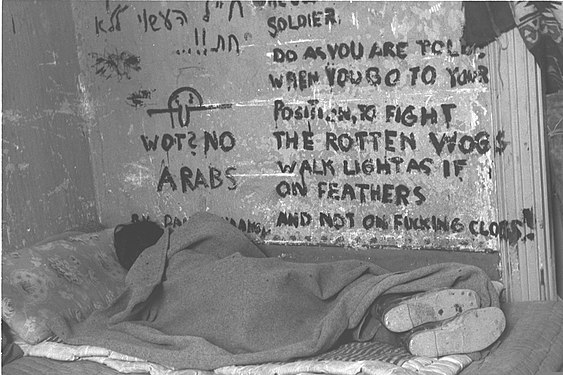
Israeli soldier sleeping during the 1947–1949 Palestine war, Kilroy is seen on the wall together with inscription "Wot? No Arabs", 1948
-
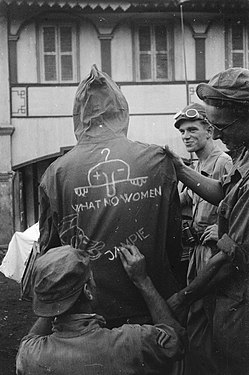
Comrades had drawn Kilroy together with the argument "What no women", the head of Donald Duck and the word "Jampie" on the back of a rain jacket of a Dutch soldier, 1948
References [edit]
- ^
- "Kilroy was here". Dictionary.com.
- Edwards, Phil (11 Dec 2015). "The World War II meme that circled the earth". Vocalism.
- Keep, Lennlee (viii Oct 2020). "From Kilroy to Pepe: a Brief History of Memes". Independent Lens. PBS.
- Strauss, Bob (11 March 2019). "The Story Behind the Phrase "Kilroy Was Here"". ThoughtCo.
- Stilwell, Blake (half dozen August 2020). "'Kilroy Was Here' was the WWII-era viral meme". We Are The Mighty.
- Moyle, Taylor (31 July 2018). "The Story Behind Kilroy, Probably the First Meme to Be". INSH.
- Carter, Elliot. "There'south a hidden military meme engraved on the World War Two Memorial". Atlas Obscura.
- ^ a b c d e Shackle, Eric (7 Baronial 2005). "Mr Chad And Kilroy Live Over again". Open Writing. Retrieved 23 May 2010.
- ^ a b c "What'southward the origin of "Kilroy was here"?". The Straight Dope. 4 August 2000.
- ^ "Needed: some groovy new "liars"". Life. Fourth dimension. 17 May 1948. p. 120.
- ^ a b Brewer's: Cassell, 1956. p. 523.
- ^ a b c d Quinion, Michael. "Kilroy was hither". Globe Broad Words . Retrieved 13 June 2010.
- ^ Sickels, Robert (2004). "Leisure Activities". The 1940s. Greenwood Publishing Group. p. 113. ISBN9780313312991.
- ^ a b Brown, Jerold E. (2001). "Kilroy". Historical dictionary of the U.S. Army. Greenwood Publishing Group. p. 264. ISBN0-313-29322-8.
- ^ Rottman, Gordon L.: FUBAR: Soldier Slang of Earth War II ISBN 978-1-84603-175-five
- ^ Capa, Robert (1947). Slightly Out of Focus. Henry Holt and Co.
- ^ Patridge, Eric; Beale, Paul (1986). A dictionary of take hold of phrases: British and American, from the sixteenth century to the present 24-hour interval. Routledge. p. 136. ISBN0-415-05916-X.
- ^ a b O'Donnell, Richard W. (Wintertime 1989). "Kilroy was Here". Naval History. United States Naval Institute. 3 (ane): 36.
- ^ Shackle, Eric. "Mr. Chad and Kilroy live once again". Eric Shackle's eBook - Chad & Kilroy . Retrieved 2 February 2020.
In 1943, 32,000 employees worked at the Fore River Shipyard. One of them was James J. Kilroy, a Welding Inspector. He used chalk to marker the rivets and plates he inspected. The "Kilroy Was Here" mark was found throughout the The statesSouth. Massachusetts Battleship and many others.
- ^ "Kilroy Was Here". In Transit. Amalgamated Transit Union. 54–55: 14. 1946.
- ^ a b "Transit Association Ships a Street Automobile To Shelter Family of 'Kilroy Was Here'", The New York Times, 24 Dec 1946.
- ^ a b c Martin, Gary. "Kilroy was hither". Phrases.org.u.k. . Retrieved 23 May 2010.
- ^ Associated Press (fourteen Nov 1945). ""Kilroy" Mystery is Finally Solved". The Lewiston Daily Sun.
- ^ a b "WW2 People'south War – Mr. Chad". BBC. 24 January 2005. Archived from the original on 7 March 2010. Retrieved 23 May 2010.
- ^ a b c d eastward f Reeve, Elizabeth (18 March 1946). "Wot! Chad's Hither". Life Mag . Retrieved xiv June 2010.
- ^ Partridge, Eric; Beale, Paul (2002). A lexicon of slang and unconventional English: colloquialisms and grab phrases, fossilised jokes and puns, general nicknames, vulgarisms and such Americanisms as take been naturalised (8 ed.). Routledge. p. 194. ISBN0-415-29189-5.
- ^ a b Zakia, Richard D. (2002). Perception and imaging. Focal Press. p. 245. ISBN0-240-80466-X.
- ^ "Changing Patterns in World Graffiti". Ludington Daily News. 16 March 1977. Retrieved thirteen June 2010.
- ^ McKie (Smallweed), David (25 Nov 2000). "Dimpled and pregnant". The Guardian . Retrieved 14 June 2010.
- ^ "Wot no respect?". RAF Related Legends. RAF Cranwell Apprentices Clan. nine Dec 2009. Archived from the original on 18 August 2010. Retrieved 14 June 2010.
- ^ Plimer, Denis (one Dec 1946). "No. i Putter". Los Angeles Times. Archived from the original on iv February 2014. Retrieved 13 June 2010.
- ^ "Mr. Chad travels". Schenectady Gazette. 12 Oct 1946. Retrieved 13 June 2010.
- ^ "There Are Places Nobody Always Was Before, but Look, Kilroy Was There". The Milwaukee Journal. 28 Nov 1946. Retrieved 14 June 2010.
- ^ "Once Honorably Discharged, Kilroy is Here, but No Smoe". The Milwaukee Journal. 9 December 1946. Retrieved 14 June 2010.
- ^ Stewart, John Laurence (1998). The forbidden diary: a B-24 navigator remembers. McGraw-Colina. p. 45. ISBN0-07-158187-1.
- ^ "Messages to the Editor: Miscellany". Life Mag. 16 Nov 1962. Retrieved 14 June 2010.
- ^ Nelson, Harry (xi September 1966). "Wall writers turn away from big-nosed favorite of World War Two: Kilroy Was Here, just Oger and Overby Take Over". Los Angeles Times . Retrieved fourteen June 2010.
- ^ a b c d e Dziatkiewicz, Łukasz (4 November 2009). "Kilroy tu był". Polityka (in Polish). Retrieved xiii June 2010.
- ^ Chas. Demee MFG. Co. (nine Nov 1946). "At terminal Kilroy is here (advert)". Billboard . Retrieved xiv June 2010.
- ^ "American notes & queries: a journal for the curious". five–half dozen. 1945.
- ^ Palveleva, Lily (24 March 2008). Ключевое слово: "граффити". Радио Свобода (in Russian). Retrieved 30 August 2010.
- ^ "r/WWII - Bringing back an quondam WW2 meme". reddit.
- ^ Donahue, Francis (1964). The Dramatic Globe of Tennessee Williams. New York: Ungar. p. 64.
- ^ Ascari, Maurizio; Corrado, Adriana (2006). Sites of commutation: European crossroads and faultlines. Internationale Forschungen zur allgemeinen und vergleichenden Literaturwissenschaft. Vol. 103. Rodopi. p. 211. ISBN90-420-2015-6.
- ^ Go, Flying! The Unsung Heroes of Mission Control. p. 133.
- ^ ""M*A*Southward*H" The Jitney (Idiot box Episode 1975)". IMDb.
- ^ Sawyer, Corinne Holt (1984). "Kilroy Was Here-But He Stepped Out for a Infinitesimal! Absentee Characters in Popular Fiction (With Particular Attention to M*A*S*H)". The Periodical of Pop Culture. 18 (2): 157–169. doi:10.1111/j.0022-3840.1984.1802_157.x.
- ^ Melvin, Morris (January 2007). "Kilroy Was Here--On Stamps". U.Due south. Stamp News. thirteen (1): 30. ISSN 1082-9423.
- ^ NBC's Customs Intro, archived from the original on eighteen Nov 2021, retrieved 26 June 2020
- ^ Kingfisher, T. (October 2019). The Twisted Ones (First Saga Press hardcover ed.). London. ISBN978-1-5344-2957-4. OCLC 1047528633.
Further reading [edit]
- Kilroy, James J. (12 January 1947). "Who Is 'Kilroy'?". The New York Times Magazine. p. xxx. Archived from the original on 3 March 2016. Retrieved six June 2014.
- Walker, Raymond J. (July 1968). "Kilroy was here: A history of scribbling in ancient and modern times". Hobbies: The Magazine for Collectors. 73: 98N–98O. ISSN 0018-2907.
External links [edit]
- The Legends of "Kilroy Was Here" by Patrick Tillery
- "What's the origin of 'Kilroy was here'?", The Straight Dope
- On the fable from snopes.com
- Republic of chad drawn in an army album from 21 June 1944 by Ron Goldstein, with the explanation "Wot! Exit again?" The album is now held at the Majestic War Museum.
Source: https://en.wikipedia.org/wiki/Kilroy_was_here
0 Response to "Draw This Again Meme 3 Blank"
Postar um comentário